Technology is changing how businesses attract customers, manage daily work, and compete in the market.
Artificial intelligence (AI), automation, and connected digital tools are becoming more useful for everyday business tasks. But using more technology does not automatically mean a business will grow.
As we look toward 2027, the bigger opportunity is to use technology to solve real problems, save time, improve customer experiences, and make better decisions.
Businesses do not need to change everything at once. They can start by understanding the trends that matter, identifying their biggest challenges, and choosing practical steps that fit their goals.
In this guide, we will explore seven business trends expected to remain important as we move toward 2027 — and what businesses can do now to prepare.
What Will Change for Businesses in 2027?
The next stage of digital growth is not just about buying new software or adding AI to every process.
Businesses will need to think more carefully about how technology fits into their operations. They will need to consider the value it creates, the data it uses, the problems it solves, and the experience it provides to customers.
Some businesses may focus on automation. Others may improve their websites, connect existing systems, or introduce AI to specific tasks.
The right approach will depend on each business. The goal is to make technology useful, manageable, and connected to real business needs.
1. AI Agents Will Move From Experiments to Real Business Work
AI agents are becoming an important area of business technology.
Unlike a basic chatbot that mainly answers questions, an AI agent can be designed to complete a series of steps toward a goal. Depending on its permissions and tools, it may gather information, organize data, use connected systems, or help complete a workflow.
For example, a sales team might use an AI agent to review incoming enquiries, organize lead details, prepare a summary, and suggest a follow-up. A team member can then review the information and decide what to do next.
However, AI agents are not perfect. They can make mistakes, misunderstand requests, or produce unreliable results. Some tasks still require human approval, especially when money, private data, or important decisions are involved.
Businesses should also be careful about the difference between a promising demonstration and a reliable system that works in everyday operations. Industry forecasts have warned that some agentic AI projects may be cancelled when costs, risks, or business value are not properly managed.
What Should Businesses Do Now?
Start with one clearly defined task rather than trying to automate an entire department.
Choose a task that is repetitive, time-consuming, and easy to measure. Test the system with appropriate human oversight, check the results, and expand only when it proves useful.
The aim is not to use AI because it is popular. The aim is to make a real business process better.
2. AI Search Will Change How Customers Find Businesses
Customers have traditionally searched for products and services through search engines, websites, and online directories.
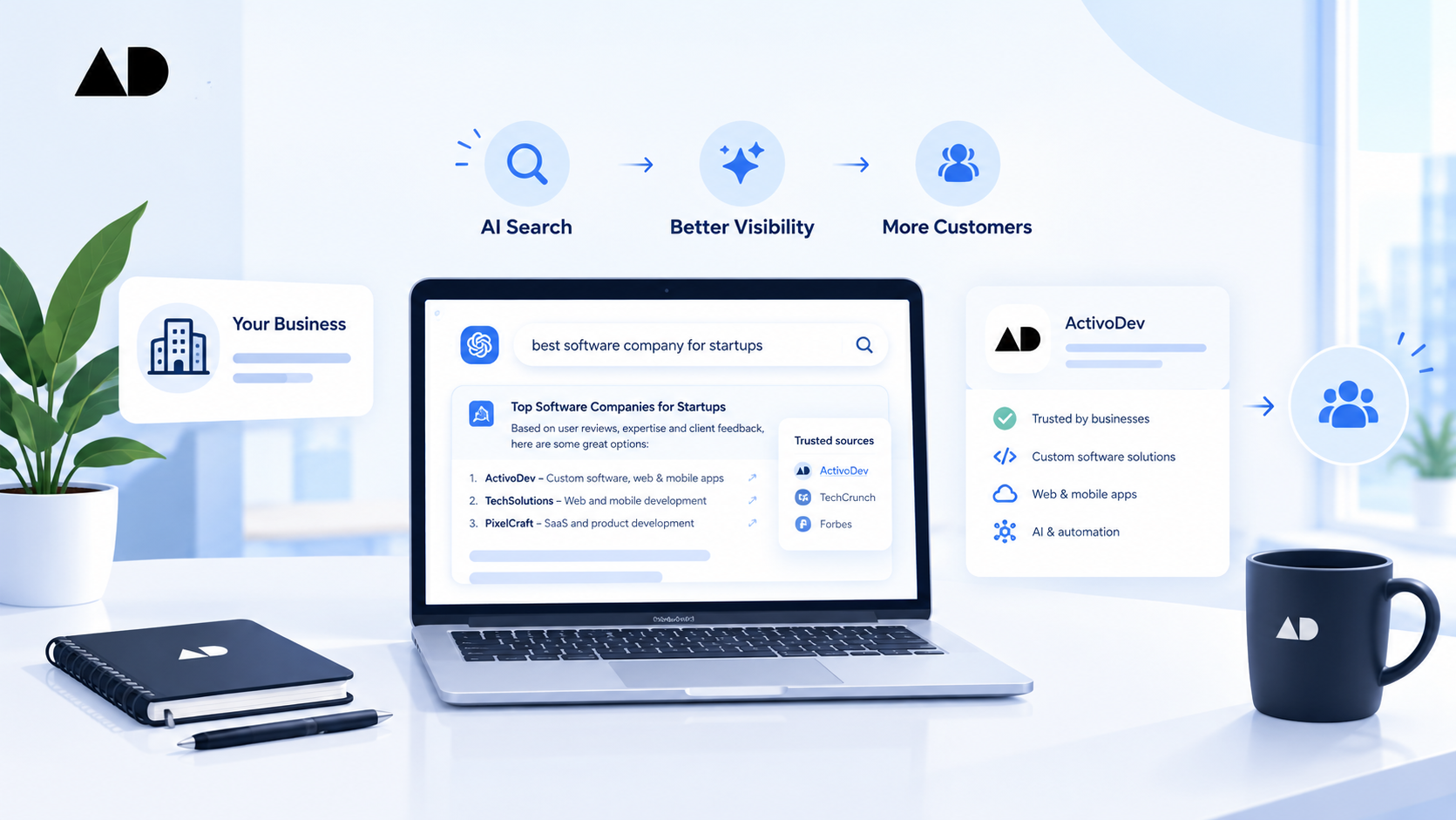
Now, people are also using AI-powered tools to ask questions, compare options, and discover information. These experiences include Google AI Overviews, Google's AI search experiences, ChatGPT search, and Perplexity.
This creates another reason for businesses to maintain a clear and trustworthy online presence.
Imagine someone asking an AI search tool, "What should I look for when choosing a software development company?" The answer may draw on information from different websites and sources. A business with useful, accurate, and clearly written content has a better foundation for being understood and considered.
However, there is no guaranteed method to make an AI system mention a particular company. Results can change depending on the question, source information, and search experience.
What Should Businesses Do Now?
- Clearly explain what the business does and who it helps.
- Create helpful content that answers real customer questions.
- Keep company details and service information accurate.
- Make important pages easy to navigate.
- Build a trustworthy website with useful information and relevant internal links.
Traditional SEO still matters. Businesses should build on good SEO practices while also making their information clear and useful for AI-powered search experiences.
For more detail, read our guide: How to Get Your Business Found in AI Search in 2026.
3. AI ROI Will Matter More Than AI Hype
AI is attracting attention across many industries, but businesses should not judge success by how many AI tools they use.
The more important question is whether a tool creates measurable value.
For example, a company might introduce AI to help its customer support team answer common questions. To evaluate the result, it could measure response times, the number of enquiries handled, customer satisfaction, and the amount of time employees save.
Another business might use AI to summarize reports or organize documents. Its results could be measured through time saved, fewer manual steps, or fewer errors.
Not every AI project will produce the same results. The value depends on the problem, the quality of the solution, and how well the tool fits into the business.
What Should Businesses Do Now?
Before investing in an AI solution, answer three questions:
- What specific problem are we trying to solve?
- How will we measure improvement?
- What will the solution cost to build, operate, and maintain?
Set a starting measurement before introducing the tool. After implementation, compare the results against that starting point.
This makes it easier to decide whether to continue, improve, or stop a project.
4. Automation Will Become Part of Normal Business Operations
Many businesses still rely on employees to repeat the same administrative steps every day.
A new enquiry may need to be copied into a spreadsheet, entered into a CRM, assigned to a team member, and followed up by email. Each step takes time, and manual work can lead to delays or missed information.
Automation can connect these steps so that one action triggers the next.
For example:
Before automation:
A customer submits a form. An employee checks the submission, copies the details into a CRM, assigns the lead, and sends a follow-up message manually.
With a suitable automated workflow:
The enquiry is recorded, the CRM is updated, the lead is assigned, and an approved follow-up message is prepared or sent according to the business rules.
Employees can then focus more on conversations, decisions, and tasks that require personal attention.
Automation is not limited to large companies. Smaller businesses can also benefit from improving a few repetitive processes.
What Should Businesses Do Now?
Identify three tasks that your team repeats frequently.
For each task, ask:
- How much time does it take?
- How often does it happen?
- What errors or delays occur?
- Could a simple workflow make it easier?
Start with the task that offers a useful improvement without adding unnecessary complexity.
If you want to understand practical examples, read our guide: AI Automation for Small Businesses: 7 Tasks You Can Automate in 2026.
5. AI Security Will Become a Business Growth Issue
As businesses introduce more AI tools, they must also think about how those tools access and use information.
An AI system may work with customer enquiries, internal documents, sales information, or other business data. If permissions are poorly managed, sensitive information could be exposed or used in an inappropriate way.
Businesses also need to consider incorrect AI outputs, unreliable third-party tools, unauthorized access, and the risks of allowing systems to take actions without suitable checks.
Security is not only a technical concern. A data incident can affect customer trust, daily operations, and a company's reputation.
What Should Businesses Do Now?
- Give each system access only to the information it needs.
- Avoid entering sensitive information into unapproved AI tools.
- Review the privacy and security practices of third-party services.
- Require human approval for important or high-risk actions.
- Monitor automated systems and keep their access permissions up to date.
Businesses should consider security from the beginning of an AI project, rather than treating it as a final step.
The right controls will depend on the type of data, the industry, and the actions the system is allowed to perform.
6. Websites Will Need to Be Ready for AI-Powered Customers
A business website is more than an online brochure. It helps potential customers understand a company, evaluate its services, and decide whether to make contact.
As AI-powered search and discovery continue to develop, clear website information will remain important.
A visitor should be able to understand what the business offers, who its services are for, what problems it solves, and how to take the next step.
The same clarity also helps search systems interpret a website's content.
A website with vague service descriptions, outdated contact information, confusing navigation, or thin content may struggle to communicate its value to visitors.
What Should Businesses Do Now?
Review your website from the perspective of a potential customer.
Check whether:
- Your services are explained in clear language.
- Your contact details and company information are accurate.
- Each important service has useful, relevant information.
- Your website works well on mobile devices.
- Your pages load reliably and are easy to navigate.
- Your content answers the questions customers actually ask.
- Related pages link to one another where it is helpful.
Do not create content simply to attract AI systems. Create useful information for people first, and make sure the website presents that information clearly.
For businesses that need a stronger digital foundation, Web Development can help connect website design, usability, performance, and business goals.
7. Businesses Will Connect Their Technology Instead of Adding More Separate Tools
Many companies use different tools for different tasks: a website for enquiries, a CRM for customer records, accounting software for payments, spreadsheets for reporting, and separate applications for communication.
These tools may work well individually but create extra work when they do not share information properly.
Employees may have to copy data between systems, update the same information more than once, or switch between several applications to complete a single task.
Connected systems can reduce this friction.
For example, a website enquiry could flow into a CRM, trigger an internal notification, and become part of a reporting dashboard. The exact workflow depends on the tools involved and the business's requirements.
Sometimes an integration between existing tools is enough. Other businesses may need custom software to support a process that standard products cannot handle well.
What Should Businesses Do Now?
Before buying another tool, review the systems you already use.
Ask:
- Which systems store the same information?
- Where do employees manually copy data?
- Which tasks are delayed because systems do not communicate?
- Can existing tools be connected through reliable integrations?
- Is there a genuine need for custom software?
The goal is not to connect everything without a reason. It is to create a simpler, more reliable way for information to move through the business.
When standard tools cannot meet a business's needs, Custom Software Development may help create a solution around its specific processes.
What Should Businesses Do Before 2027?
Businesses do not need to adopt every new technology to prepare for 2027. A focused plan is often a better starting point.
Here are five practical steps.
Step 1: Identify Repetitive Work
Look for tasks that happen frequently and follow predictable steps. Examples include data entry, routine follow-ups, report preparation, and moving information between systems.
Write down how each task currently works before deciding whether to change it.
Step 2: Choose One Process to Improve
Select a process where delays, manual work, or mistakes create a real problem.
Estimate how much time it takes today and what improvement would make a difference. Avoid starting with a complicated project when a smaller change could help.
Step 3: Find the Right Role for AI
Consider whether AI could help with research, summarization, classification, drafting, or decision support.
Not every task needs AI. A simple rule-based automation may be cheaper, easier to test, and more reliable for predictable work.
Choose the approach that fits the task.
Step 4: Connect Existing Systems
Review the tools your team already uses. Better integration may remove duplicate work and improve the flow of information without requiring an entirely new platform.
If important gaps remain, consider whether a more tailored solution is justified.
Step 5: Measure Results Before Scaling
After making a change, compare the results with your starting measurements.
Look at time saved, error rates, response times, customer feedback, and operating costs where relevant.
If the improvement is clear, consider expanding the solution. If not, find out why before investing more.
Don't Try to Automate Everything
Technology can improve many business processes, but automation is not the right answer for every situation.
Some work depends on human judgment, creativity, empathy, negotiation, and relationships. Sensitive decisions may also require a person to review the information and take responsibility for the outcome.
AI can support employees by organizing information, preparing drafts, or reducing repetitive work. But businesses should decide carefully which tasks can be automated and which need human involvement.
A useful principle is simple:
Use technology to remove unnecessary work, not to remove human judgment where it matters.
The best solution is the one that improves the work while keeping the right level of human control.
The Businesses That Prepare Early Will Have an Advantage
Preparing for 2027 does not mean predicting every new technology or making a large investment immediately.
It means understanding where the business loses time, where customers need a better experience, and where existing systems create unnecessary friction.
Some companies may benefit most from improving their websites. Others may gain more from automation, better data management, AI-assisted work, or connected software.
There is no single solution that fits every business.
The strongest starting point is to understand your current needs, set a clear goal, test a practical improvement, and learn from the results.
Final Thoughts
As we move toward 2027, AI, automation, security, search, and connected digital systems are likely to remain important areas for businesses to watch.
But technology alone does not guarantee growth.
A tool creates value when it solves a real problem, fits the way people work, and produces an improvement the business can measure.
You do not need to change everything at once. Start with one challenge, choose the right solution, protect your information, and build from there.
The businesses best prepared for 2027 will not necessarily be the ones using the most technology. They will be the ones that know where technology can create real value.
Quick Takeaways
- Choose technology based on business needs, not hype.
- Test AI agents on clear, manageable tasks.
- Keep your website useful, accurate, and easy to understand.
- Use automation to reduce repetitive work.
- Measure AI and automation results before scaling.
- Treat security and data access as essential considerations.
- Connect existing tools when doing so improves operations.
- Keep human judgment involved where it matters.
Frequently Asked Questions
1. What are the biggest business technology trends for 2027?
Important trends to watch include AI agents, AI-powered search, business automation, measurable returns on AI investment, AI security, clearer business websites, and better-connected digital systems. The impact of each trend will depend on the business and its industry.
2. Will AI agents replace employees in 2027?
AI agents may handle some tasks that currently require manual work, but they are not a complete replacement for employees. Many business processes still need human judgment, communication, creativity, and accountability. Businesses should evaluate AI based on the task and the results it delivers.
3. How can a small business prepare for 2027?
Start by identifying repetitive work, improving your website, reviewing your existing tools, and choosing one process to improve. Test any new solution on a manageable scale and measure the results before expanding it.
4. Should businesses invest in AI now?
Businesses should consider AI when it can solve a clear problem or improve a useful process. Before investing, assess the expected benefits, implementation costs, data requirements, security risks, and ongoing maintenance.
5. Is traditional SEO still important in 2027?
Yes, SEO remains an important foundation for helping people discover and understand a business online. Businesses can build on it by creating useful content, keeping information accurate, improving website structure, and making their services clear for both people and AI-powered search experiences.
6. What should businesses automate first?
Start with repetitive, predictable tasks that take time or frequently cause delays. Lead routing, routine follow-ups, document processing, data entry, and reporting may be suitable candidates. Choose based on your actual workflow rather than automating a task simply because a tool supports it.
Ready to Build a Business That's Prepared for 2027?
The right technology can help your business work more efficiently, serve customers better, and build a stronger digital foundation.
ActivoDev helps businesses explore practical digital solutions, including custom software, web development, AI integration, and business automation.
Whether you need to improve an existing process, connect your systems, or build a new digital solution, start with the business problem you want to solve.
Explore our services:
Let's build technology that supports real business growth.