
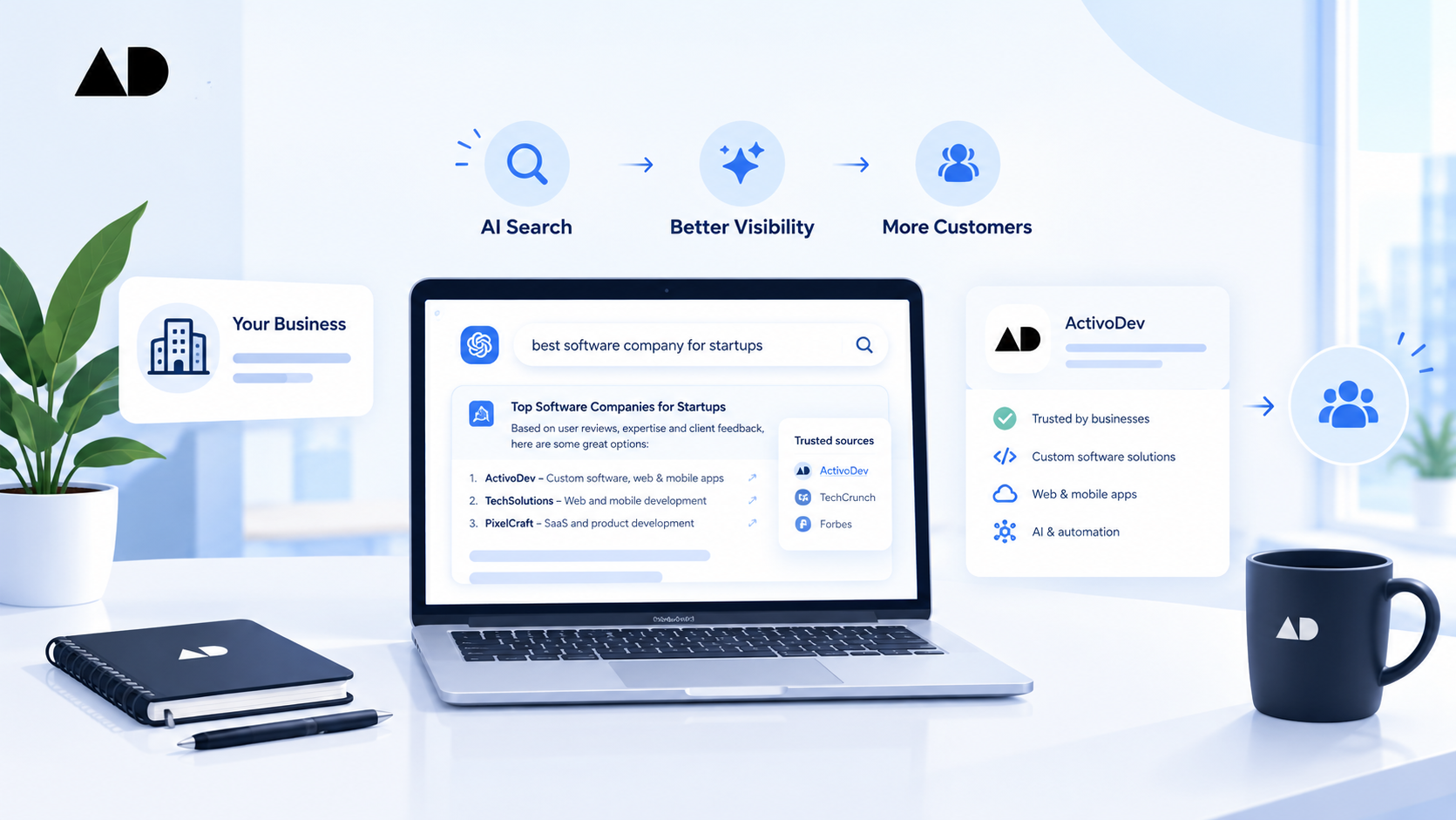
Search is changing.
For years, businesses focused on one main goal: rank higher on Google.
That still matters.
But customers now have another way to find businesses, products, services, and answers.
They ask tools like ChatGPT, Google AI Mode, Google AI Overviews, and Perplexity questions directly.
Instead of receiving a list of ten links, they may receive a summarized answer — sometimes with specific businesses, products, or websites mentioned as sources.
So a new question is becoming important for businesses:
When someone asks AI about your industry, will your business be part of the answer?
Let's look at how businesses can prepare.
What Is AI Search?
AI search is a way of finding information by asking an AI-powered search system a question in natural language.
For example, instead of searching:
"best CRM software for small business"
a business owner might ask:
"What CRM should a small business use if it has a five-person sales team and wants simple automation?"
The AI system can understand the context and provide a more conversational answer.
Depending on the platform and query, it may also provide links or citations to websites it used as sources.
This changes the way businesses need to think about online visibility.
You don't only want your website to rank.
You also want your business and content to be understood, trusted, and referenced.
How Is AI Search Different From Traditional Google Search?
Traditional search generally gives users a list of pages.
The user then:
- Searches for something
- Opens several results
- Compares information
- Decides which source to trust
AI search can compress some of this process.
A user can ask a detailed question and receive a summarized response with relevant sources.
For example:
Traditional search:
"AI automation companies in Pakistan"
AI search:
"I'm a small business owner in Pakistan. Which type of AI automation should I implement first, and what kind of company can help me build it?"
The second question contains more context and intent.
This means businesses need content that answers real customer questions, not just content written around keywords.
What Are Google AI Overviews, ChatGPT Search & Perplexity?
Several AI-powered search experiences are now competing for users' attention.
Google AI Overviews & AI Mode
Google has integrated generative AI directly into Search.
AI Overviews can provide an AI-generated summary for certain searches, while AI Mode allows users to have more conversational and detailed search experiences.
ChatGPT
People increasingly use ChatGPT not only to generate text, but also to research products, services, businesses, technologies, and solutions.
For businesses, this creates another potential discovery channel.
Perplexity
Perplexity is designed around AI-powered search and answers, often showing citations alongside its responses.
The important point isn't which platform wins.
The important point is that customers have more ways to research businesses than before.
What Is GEO?
You may have heard another term recently:
GEO — Generative Engine Optimization.
In simple words, GEO means improving your online presence so that AI-powered search systems can better understand, reference, and potentially recommend your business.
Traditional SEO focuses heavily on helping pages appear in search results.
GEO focuses more on visibility inside AI-generated answers.
But there is an important point:
GEO does not mean abandoning SEO.
Your website still needs strong technical foundations, useful content, clear structure, and good search visibility.
Think of it this way:
SEO helps people find your website.
GEO helps AI systems understand and potentially reference what your business offers.
The two strategies can work together.
Why Traditional SEO Isn't Enough Anymore
Imagine two companies.
Both have websites.
Both publish blog posts.
Both target similar keywords.
But Company A clearly explains:
- What it does
- Who it serves
- Which industries it works with
- Which technologies it uses
- What problems it solves
- What services it provides
- Examples of its expertise
Company B has vague pages filled with generic marketing statements.
Which one is easier for an AI system to understand?
Probably Company A.
This is why clarity and authority are becoming increasingly important.
AI systems need enough reliable information to understand what a business actually does.
How Does AI Search Decide Which Businesses to Mention?
There isn't one simple "GEO ranking formula."
Different AI systems work differently.
However, businesses can make themselves easier to understand and verify by building a strong online presence.
Some important signals include:
1. Clear Business Information
Your website should clearly explain who you are and what you do.
Don't make visitors — or AI systems — guess.
2. Helpful, Specific Content
Create content that answers real questions your customers ask.
3. Consistent Information
Your company name, services, descriptions, and other important information should be reasonably consistent across your website and other reputable sources.
4. Demonstrated Expertise
Case studies, technical articles, original research, documentation, and useful guides can help demonstrate expertise.
5. Third-Party References
Mentions from reputable websites, publications, industry communities, and other relevant sources can provide additional context around your business.
6. Strong Website Structure
Clear headings, descriptive page titles, internal links, and logically organized content make your website easier to navigate and understand.
7 Ways to Improve Your AI Search Visibility
Now let's make this practical.
1. Answer the Questions Your Customers Actually Ask
Don't only write articles such as:
"What Is Artificial Intelligence?"
That topic is extremely broad.
Instead, answer questions closer to a customer's decision:
"How much does AI automation cost for a small business?"
"What business processes should I automate first?"
"Should I build custom software or use an existing SaaS tool?"
These questions have clearer business intent.
2. Make Your Service Pages Extremely Clear
Your service page shouldn't just say:
"We deliver innovative digital solutions."
That's too vague.
Instead, explain:
- What the service is
- What problems it solves
- Who needs it
- What technologies are involved
- What the development process looks like
- What outcomes businesses can expect
- Frequently asked questions
A clear service page is useful for both humans and search systems.
3. Build Topic Authority
Don't publish one article about AI and then move to an unrelated topic.
Build groups of useful content around important areas.
For example, ActivoDev could build an AI & Automation content cluster around:
AI Agents → AI Automation → AI Search → AI Chatbots → Business Automation → AI Integration
This creates a stronger connection between related topics.
It also gives you opportunities to link articles together naturally.
4. Use Internal Links
Internal links help users discover related information.
They also help search engines understand how your website content is connected.
For example:
AI Automation → AI Agents → AI & ML Integration
If someone is reading about AI automation and wants to understand AI agents, linking to your detailed AI agents guide makes sense.
5. Show Real Expertise
AI visibility isn't just about producing more content.
More content doesn't automatically mean better visibility.
Instead, create content that demonstrates actual knowledge.
For example:
- Real development lessons
- Case studies
- Technical comparisons
- Implementation guides
- Original examples
- Practical business frameworks
- Mistakes to avoid
- Cost considerations
The goal is simple:
Give people something genuinely useful.
6. Keep Your Business Information Consistent
Imagine your website says:
"ActivoDev provides custom software development and AI solutions."
But another website describes the company completely differently.
Or your services are outdated.
Or your contact information is inconsistent.
This creates unnecessary confusion.
Keep important business information accurate and consistent across your website and relevant business profiles.
7. Create Content for Humans First
This might be the most important point.
Don't write articles that sound like they were created only to satisfy an algorithm.
Write for the person asking the question.
Use:
- Clear headings
- Short paragraphs
- Simple explanations
- Examples
- Lists where useful
- Direct answers
- Helpful FAQs
If humans find your content useful, you're already moving in the right direction.
Does GEO Replace SEO?
No.
This is one of the biggest misconceptions around AI search.
SEO is not disappearing.
Search engines still need websites, pages, links, structured information, and useful content.
At the same time, AI-powered search is creating new ways for users to discover information.
So instead of:
SEO OR GEO
think:
SEO + GEO
Your long-term strategy should make your business visible across traditional search and AI-powered discovery.
How to Make Your Website Easier for AI to Understand
Start with the basics.
Your website should clearly communicate:
Who Are You?
Explain your company in simple language.
What Do You Offer?
List your services clearly. If you offer Custom Software Development, explain what you build, who it is for, and what outcomes it delivers.
Who Do You Help?
Mention the types of businesses, industries, or customers you serve.
What Problems Do You Solve?
Talk about outcomes, not just technologies.
How Do You Work?
Explain your development or service process.
Why Should Someone Trust You?
Show expertise through work, case studies, useful content, testimonials, or other credible evidence where available.
This sounds simple.
But many business websites make these answers surprisingly difficult to find.
How to Build Content AI Systems Can Trust
Think beyond blog posts.
A strong content ecosystem can include:
- Service pages
- Blog articles
- Case studies
- FAQs
- Documentation
- Industry guides
- Comparison articles
- Original research
- Company information
- Author information
- Customer success stories
The more clearly your website communicates your expertise, the easier it becomes for people — and search systems — to understand your business.
How Can You Measure AI Search Visibility?
This is still an emerging area.
You can start simple.
Create a list of questions your potential customers might ask AI.
For example:
"Who provides custom software development for startups?"
"What is the best way to automate business workflows?"
"Who can build an AI chatbot for a business?"
"What should a company consider before building custom software?"
Then test these questions across relevant AI search platforms.
Track:
- Is your company mentioned?
- Is your website cited?
- Are your services described correctly?
- Which competitors appear?
- Which sources are being referenced?
Repeat the process regularly.
Over time, this gives you a basic AI visibility benchmark.
Common GEO Mistakes Businesses Make
Mistake 1: Thinking GEO Is Just Adding More Keywords
It isn't.
Mistake 2: Creating Hundreds of Generic AI-Generated Articles
More content doesn't automatically create authority.
Mistake 3: Ignoring Traditional SEO
AI search and traditional search are connected.
Mistake 4: Having Unclear Service Pages
If humans can't understand what you offer, AI systems may struggle too.
Mistake 5: Writing Only Promotional Content
Useful educational content can build much more trust than constant sales messaging.
Mistake 6: Never Checking How AI Describes Your Business
You may be surprised by what different AI systems say about your company.
A Simple 30-Day AI Visibility Plan
You don't need to rebuild your entire website tomorrow.
Start small.
Week 1 — Fix the Basics
Review your:
- Homepage
- About page
- Service pages
- Contact information
- Business descriptions
Make sure everything is accurate and clear.
Week 2 — Create Useful Content
Publish 1–2 genuinely useful articles answering real customer questions.
Don't write for keywords alone.
Write to solve problems.
Week 3 — Connect Your Content
Add relevant internal links between:
- Blog posts
- Service pages
- Guides
- Related topics
Create a clear content structure.
Week 4 — Test AI Visibility
Ask relevant questions across AI search platforms.
Record:
- Your mentions
- Competitor mentions
- Citations
- Incorrect information
- Content gaps
Then use those findings to plan your next content.
What Should Businesses Focus on in 2026?
The biggest mistake would be treating AI search as a completely separate marketing strategy.
Instead, think about your entire digital presence.
Your website should be:
Clear → Useful → Trustworthy → Well-structured → Consistently updated
Your content should answer real questions.
Your service pages should explain real solutions.
And your business should have enough credible information online for both people and AI systems to understand what you actually do.
Final Thoughts
AI is changing how people search for information.
Google Search is becoming more conversational.
AI Overviews and AI Mode are changing the search experience.
Tools like ChatGPT and Perplexity are giving users another way to research questions, products, services, and businesses.
That doesn't mean traditional SEO is dead.
It means online visibility is becoming broader than rankings alone.
Businesses that start building useful, clear, trustworthy content now can put themselves in a stronger position as AI-powered discovery continues to grow.
The goal isn't to "hack" AI.
The goal is to make your business easy to understand, useful to customers, and credible enough to be referenced.
Quick Takeaways
- AI search is growing.
- SEO still matters.
- GEO complements SEO rather than replacing it.
- Clear service pages matter.
- Useful content matters more than content volume.
- Internal linking helps connect your expertise.
- Business information should stay accurate and consistent.
- Start measuring how AI platforms describe your business.
Most importantly:
Don't create content just to appear in AI answers. Create content worth being mentioned in.
Frequently Asked Questions
1. What Is AI Search?
AI search uses artificial intelligence to understand questions and provide conversational answers, often with links or citations to relevant web sources.
2. What Is GEO?
GEO stands for Generative Engine Optimization. It refers to strategies designed to improve how a business or its content appears in AI-generated search answers.
3. Is SEO Still Important in 2026?
Yes. SEO remains important for helping search engines discover and understand your website. GEO should generally be viewed as an additional layer, not a replacement.
4. Can a Small Business Appear in ChatGPT or Google AI Search?
Yes, but there is no guaranteed method for getting mentioned. Building a clear website, useful content, strong expertise, and a credible online presence can improve your chances of being discovered and referenced.
5. Should Every Business Start Doing GEO?
Businesses that depend on online discovery should at least start monitoring AI search visibility. You don't necessarily need a complicated GEO strategy on day one — fixing your website fundamentals and creating useful content is a strong starting point.
Build a More Visible Digital Presence
AI search is changing how customers discover businesses.
At ActivoDev, we help businesses build modern digital solutions — from custom software and web applications to AI integrations and business automation.
If you're thinking about improving your digital presence or building an AI-powered solution, let's build something that works for your business.